2D Light-cone Wedge Plot
scripts/plot_lightcone_wedge.py
Overview
The wedge plot renders a thin declination slice of a galaxy redshift survey in polar coordinates centred on the observer (Earth):
where \(d_C(z)\) is the comoving distance computed with the Planck 2018 flat ΛCDM cosmology (\(H_0 = 67.4\,\text{km\,s}^{-1}\text{Mpc}^{-1}\), \(\Omega_m = 0.315\)).
The observer sits at the origin; the fan opens to the right. Each galaxy is coloured by its redshift using the turbo colormap. Concentric arcs mark comoving distance milestones and are labelled with both \(d_C\) [Mpc] and the corresponding redshift and lookback time [Gyr].
The script produces:
Individual wedge for every requested survey, using that survey’s built-in optimal footprint slice (RA range and DEC window) unless the user overrides them.
Combined wedge (when more than one survey is requested) with each survey shown in a distinct solid colour.
Supported catalogues
Key |
FITS file |
RA col |
DEC col |
z col |
Default DEC window |
|---|---|---|---|---|---|
|
|
|
|
|
0° ± 3° |
|
|
|
|
|
0° ± 3° |
|
|
|
|
|
0° ± 2° |
|
|
|
|
|
35° ± 12° |
|
|
|
|
|
0° ± 5° |
Quality cuts applied to every catalogue: RA ∈ [0°, 360°], DEC ∈ [−90°, 90°],
\(z > 0\), and ZWARNING = 0 where that column exists.
Usage
Each survey is plotted with its own optimal footprint by default:
# All surveys — individual plots + combined, using per-survey defaults
python scripts/plot_lightcone_wedge.py

# DESI NGC only, dark background
python scripts/plot_lightcone_wedge.py --surveys DESI_NGC --dark

# GAMA G09+G12+G15 fields, dark background
python scripts/plot_lightcone_wedge.py --surveys GAMA --dark

# Equatorial combined: GAMA + SDSS + DESI NGC (explicit DEC requires --force-dec)
python scripts/plot_lightcone_wedge.py \
    --surveys GAMA SDSS DESI_NGC \
    --ra-min 120 --ra-max 240 \
    --dec-center 0 --dec-width 2 --force-dec --dark

# All five surveys, equatorial strip, dark background
python scripts/plot_lightcone_wedge.py \
    --surveys LS10 GAMA SDSS DESI_NGC DESI_SGC \
    --ra-min 120 --ra-max 240 \
    --dec-center 0 --dec-width 2 --force-dec --dark
Command-line options
Option |
Default |
Description |
|---|---|---|
|
all five |
Space-separated list of catalogue keys to plot.
Choices: |
|
|
Centre of the DEC slice in degrees.
For individual plots this is overridden by each survey’s built-in default
unless |
|
|
Half-width of the DEC slice in degrees. |
|
(flag) |
Apply |
|
|
Maximum redshift shown. |
|
|
RA lower bound [degrees]. Value |
|
|
RA upper bound [degrees]. Value |
|
|
Maximum number of galaxies plotted per survey (random downsampling applied when exceeded). |
|
(flag) |
Use a dark (#0a0a0a) background instead of white. |
|
|
Random seed for the downsampling step. |
|
(flag) |
Skip the per-survey individual plots; produce only the combined figure. |
|
(flag) |
Skip the combined multi-survey figure. |
|
|
Directory where PNG files are written (created if absent). |
Output files
Individual wedge
wedge_{SURVEY}_zmax{Z:.2f}_dec{DEC:.1f}_w{WIDTH:.1f}_{dark|light}.png
Example: wedge_DESI_NGC_zmax0.45_dec35.0_w12.0_dark.png
Combined wedge
wedge_combined_zmax{Z:.2f}_dec{DEC:.1f}_w{WIDTH:.1f}_{dark|light}.png
Example: wedge_combined_zmax0.45_dec0.0_w2.0_dark.png
Example outputs
DESI DR1 BGS Northern Galactic Cap
200 000 galaxies from DESI DR1 BGS NGC, declination slice 35° ± 12°, RA = [120°–250°], coloured by redshift.
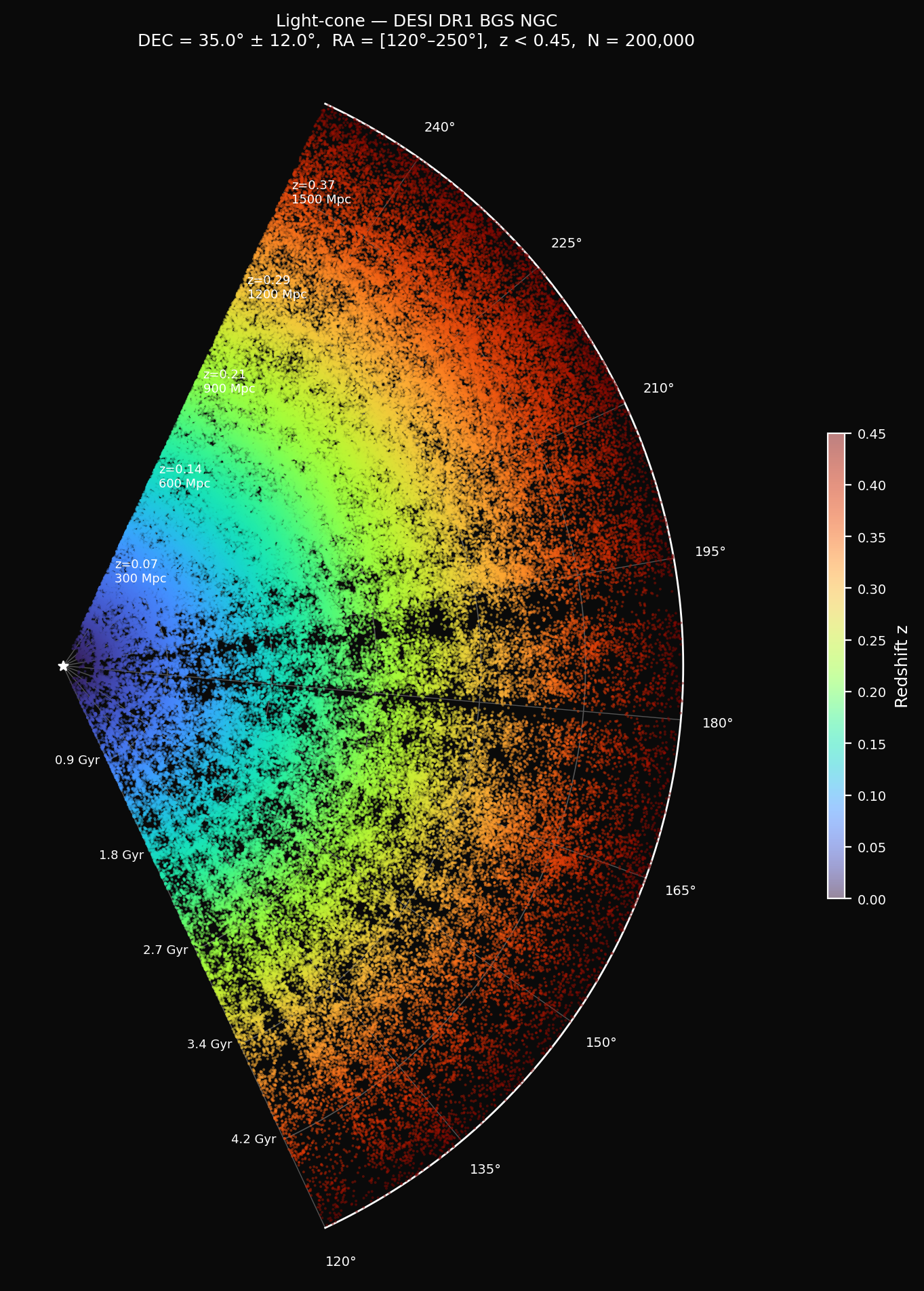
DESI DR1 BGS NGC — 200 000 galaxies in a 24°-wide declination slice centred at DEC = 35°. The cosmic web is visible as an alternation of dense filaments (bright, yellow–red) and underdense voids (dark gaps).
GAMA survey
GAMA G09 + G12 + G15 equatorial fields, declination slice 0° ± 3°, RA = [129°–222°].
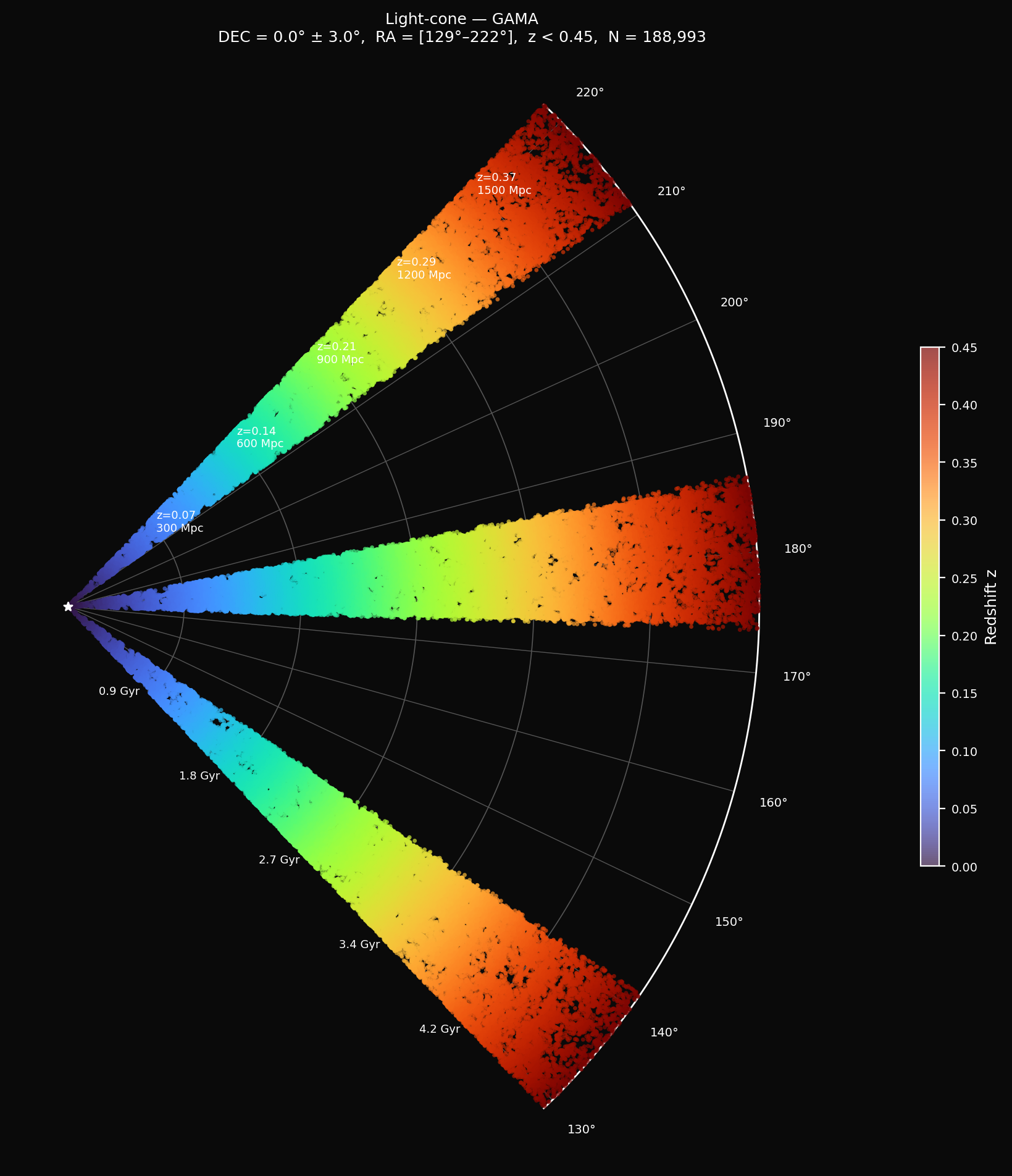
GAMA — three equatorial fields (G09, G12, G15) separated by survey gaps. The lower galaxy density compared to DESI reflects GAMA’s smaller area and deeper target selection.
Combined equatorial slice
GAMA + SDSS MPA-JHU + DESI NGC overlaid in a 4°-wide equatorial strip, RA = [120°–240°]. Each survey is drawn in a distinct colour.
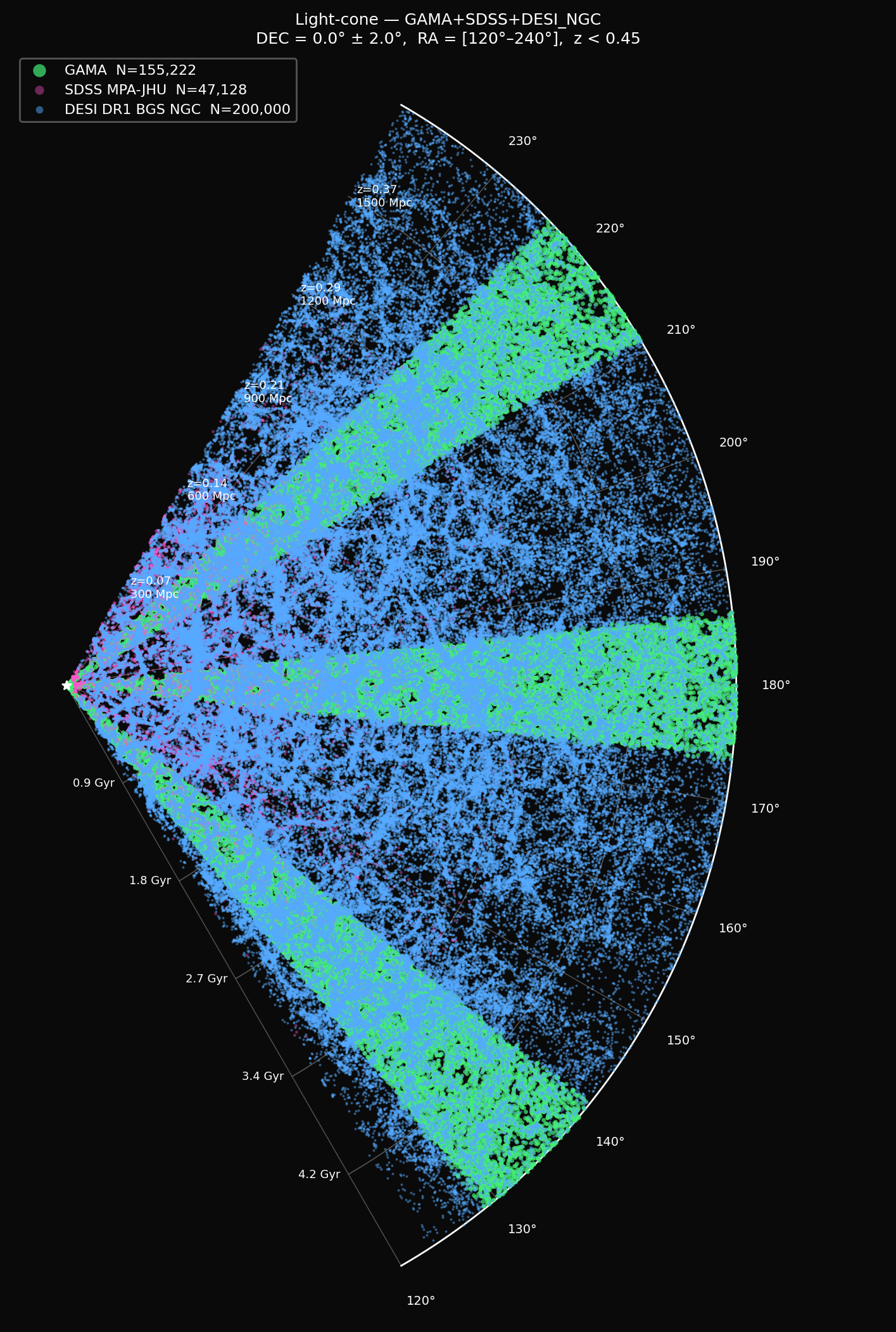
Combined wedge. Green: GAMA; pink: SDSS MPA-JHU; blue: DESI DR1 BGS NGC. DESI’s greater depth and area are evident. The three surveys overlap in the G12 and G15 fields (RA ≈ 180°–222°), allowing cross-survey comparisons.