Cosmic Shear
Ten published cosmic shear measurements catalogued in
literature_measurements/lensing/cosmic_shear/, organised by survey.
Each entry has a paper.json with full provenance (source catalog,
shear estimator, tomographic bins, angular scales, key S8 constraint).
Conventions: S8 ≡ σ₈(Ωm/0.3)0.5. All measurements are from ground-based weak lensing surveys unless noted. Planck 2018 gives S8 = 0.832 ± 0.013 for reference.
Measurement methods
Two-point shear correlations
Cosmic shear measures the coherent distortion of background galaxy shapes by large-scale foreground mass structures. The fundamental observables are the two-point shear correlation functions in tomographic redshift bins i, j:
These are related to the convergence power spectrum via Limber integration:
where qi(χ) is the lensing efficiency kernel:
The projection means cosmic shear is sensitive to a combination σ₈(Ωm/0.3)0.5 ≡ S8 rather than σ₈ and Ωmseparately. Constraints from single-probe cosmic shear are thus approximately degenerate along the S8 direction.
Alternative statistics
COSEBIs (Complete Orthogonal Sets of E/B Integrals, Schneider+2010): linear combinations of ξ± optimised to separate E-modes (lensing signal) from B-modes (null test); used in KiDS-1000 (Asgari+2021).
Bandpower spectra Cℓ: Fourier-space estimator; used in HSC (Hikage+2019, Li+2023). More naturally connected to theory predictions; less affected by survey boundary effects than ξ±.
Aperture mass statistics Map: third-order statistics (beyond 2pt); sensitive to non-Gaussianity and baryons.
Shear measurement
All ground-based surveys require PSF deconvolution to measure the small (< 1%) ellipticity signal. The three main approaches are:
lensfit (Miller+2013): forward-model Bayesian fitting of a galaxy model convolved with PSF; outputs per-galaxy posterior on ellipticity. Used by CFHTLenS and KiDS.
METACALIBRATION (Sheldon & Huff 2017): applies a small shear to the image and re-measures the shape; self-calibrates the response to shear without image simulations. Used by DES Y3.
HSMRegauss (Hirata & Seljak 2003): re-Gaussianization PSF correction; computationally fast; calibrated via image simulations. Used by HSC (same pipeline as BGS+HSC Y3 in this project).
Multiplicative bias calibration proceeds through: GREAT3 challenge → per-survey image simulations (MICE, GALSIM) → residual bias |m| calibration → uncertainty propagated to Cℓ.
Photometric redshifts and n(z) calibration
The lensing kernel q(χ) depends critically on the true redshift distribution n(z) of source galaxies. Systematic errors in n(z) shift S8 by up to 0.05. The main calibration approaches are:
BPZ / LePhare: template fitting photo-z; validated on spectroscopic overlap (zCOSMOS, VVDS).
DIR (direct calibration, Hildebrandt+2017): re-weight a deep spectroscopic training set to match the photometric colour distribution. Used in KiDS.
SOM (self-organising map, Wright+2020): group galaxies by colour and calibrate n(z) per cell from deep spectroscopy. Used in KiDS-1000 and HSC.
DNNz / DEmPz: deep neural network photo-z; used in HSC Y3.
Intrinsic alignments
The dominant systematic in cosmic shear. The NLA model:
where F(z) = -AIA C₁ ρcr Ωm / D(z). More flexible models (TATT, Blazek+2019) include additional tidal torque and source alignment terms.
Baryon feedback
Small-scale power suppression from AGN feedback shifts Cℓby 10–30% at ℓ > 1000. Parameterised through HMcode2020 (Abary, ηbary) or the OwlS/BAHAMAS simulation grid. Most analyses apply angular or k-scale cuts to mitigate this uncertainty, at the cost of information.
Status, open questions, and progress
Current status
As of 2025, cosmic shear from Stage-III surveys (KiDS, DES, HSC) has established:
S8 = 0.76–0.78 from all surveys, consistently below Planck (S8 = 0.832) at the 2–3σ level. The weighted mean across all Stage-III surveys is S8 ~ 0.77 ± 0.02.
The signal is reproducible across independently calibrated shape catalogs (lensfit, METACAL, HSMRegauss), angular scales (configuration and Fourier space), and redshift calibration methods (DIR, SOM, DNNz).
Stage-IV surveys (Euclid, LSST, Roman) will reduce statistical errors by a factor ~5, potentially resolving the S8 tension or establishing it as a definitive cosmological anomaly.
Open questions
The S8 tension: Is S8 ~ 0.77 a true cosmological signal (beyond-ΛCDM physics, dynamic dark energy, neutrino mass) or a residual systematic (IA modelling, n(z) tails, PSF leakage at small scales)? The ~3σ level makes it both statistically significant and insufficiently compelling.
Intrinsic alignments: NLA model may be inadequate at 1%-level precision. TATT and higher-order models add parameters that weaken S8 constraints. Spectroscopic overlap surveys are needed to break the IA–cosmology degeneracy.
Baryonic feedback: Scale cuts discard information. Hydrodynamical simulation predictions (BAHAMAS, IllustrisTNG, FLAMINGO) span a wide range. Joint lensing + tSZ constraints can break the degeneracy.
Non-limber corrections at low ℓ: The Limber approximation fails at ℓ < 10 for tomographic bin correlations. Matters for Stage-IV surveys.
Beyond-2pt: Third-order statistics (weak lensing bispectrum, aperture mass skewness) carry additional information and constrain non-Gaussianity, but require accurate covariances.
Progress over two decades
Year |
Milestone |
|---|---|
2000–2002 |
First cosmic shear detections (Bacon+2000, Kaiser+2000, Van Waerbeke+2000, Wittman+2000); ~30 deg² each; consistent with ΛCDM but large errors |
2012 |
CFHTLenS (Heymans+2012, Kilbinger+2013): first precision measurement (154 deg², lensfit); first hint of S8 below Planck at 2σ |
2017 |
KiDS-450 (Hildebrandt+2017): 450 deg², 4-bin tomography, DIR n(z); 2.3σ below Planck; S8 tension named and characterised |
2018 |
DES Y1 (Troxel+2018): 1321 deg², METACALIBRATION; independent confirmation at 1.7σ below Planck |
2019 |
HSC Y1 (Hikage+2019): 136 deg² but deepest (i < 24.5, neff ~ 22 arcmin⁻²); Cℓ estimator; S8 = 0.800 |
2021 |
KiDS-1000 (Asgari+2021, Heymans+2021): 1006 deg², 5-bin tomography; three statistics (ξ±, COSEBIs, Cℓ) all consistent; 3×2pt S8 = 0.766; 3σ below Planck; most precise ground-based measurement at the time |
2022 |
DES Y3 (Amon+2022, Secco+2022): 4143 deg², 100M sources, METACAL; S8 = 0.772; robustness to baryons and IA tested exhaustively |
2023 |
HSC Y3 (Li+2023, Miyatake+2023): 416 deg², Cℓ + 3×2pt; S8 = 0.769–0.763; companion analyses internally consistent; ~2σ below Planck |
2024–25 |
Euclid Q1 (Euclid+2025): first space-based cosmic shear with VIS; ~1200 deg²; expected S8 precision ~1%; will distinguish S8 tension from systematics |
Survey parameter table
Survey |
Area (deg²) |
Nbins |
Nsrc |
neff (arcmin⁻²) |
zsrc |
Shear |
Statistic |
|---|---|---|---|---|---|---|---|
CFHTLenS (Heymans+2012) |
154 |
6 |
4.2 M |
11 |
0.2–1.3 |
lensfit |
ξ+/ξ- |
CFHTLenS (Kilbinger+2013) |
154 |
1 |
4.2 M |
11 |
0.2–1.3 |
lensfit |
ξ+/ξ- (2D) |
KiDS-450 (Hildebrandt+2017) |
450 |
4 |
15 M |
8.5 |
0.1–0.9 |
lensfit |
ξ+/ξ- |
DES Y1 (Troxel+2018) |
1321 |
4 |
26 M |
5.9 |
0.2–1.3 |
IM3SHAPE+METACAL |
ξ+/ξ- |
HSC Y1 (Hikage+2019) |
136 |
4 |
11 M |
22 |
0.3–1.5 |
HSMRegauss |
Cℓ |
KiDS-1000 (Asgari+2021) |
1006 |
5 |
21 M |
6.2 |
0.1–1.2 |
lensfit (selfcal) |
ξ±, COSEBIs, Cℓ |
KiDS-1000 (Heymans+2021) |
1006 |
5 |
21 M |
6.2 |
0.1–1.2 |
lensfit (selfcal) |
3×2pt |
DES Y3 (Amon+2022) |
4143 |
4 |
100 M |
5.6 |
0.0–2.0 |
METACALIBRATION |
ξ+/ξ- |
DES Y3 (Secco+2022) |
4143 |
4 |
100 M |
5.6 |
0.0–2.0 |
METACALIBRATION |
ξ+/ξ- (scale cuts) |
HSC Y3 (Li+2023) |
416 |
4 |
25 M |
15 |
0.3–1.5 |
HSMRegauss |
Cℓ |
Summary figure
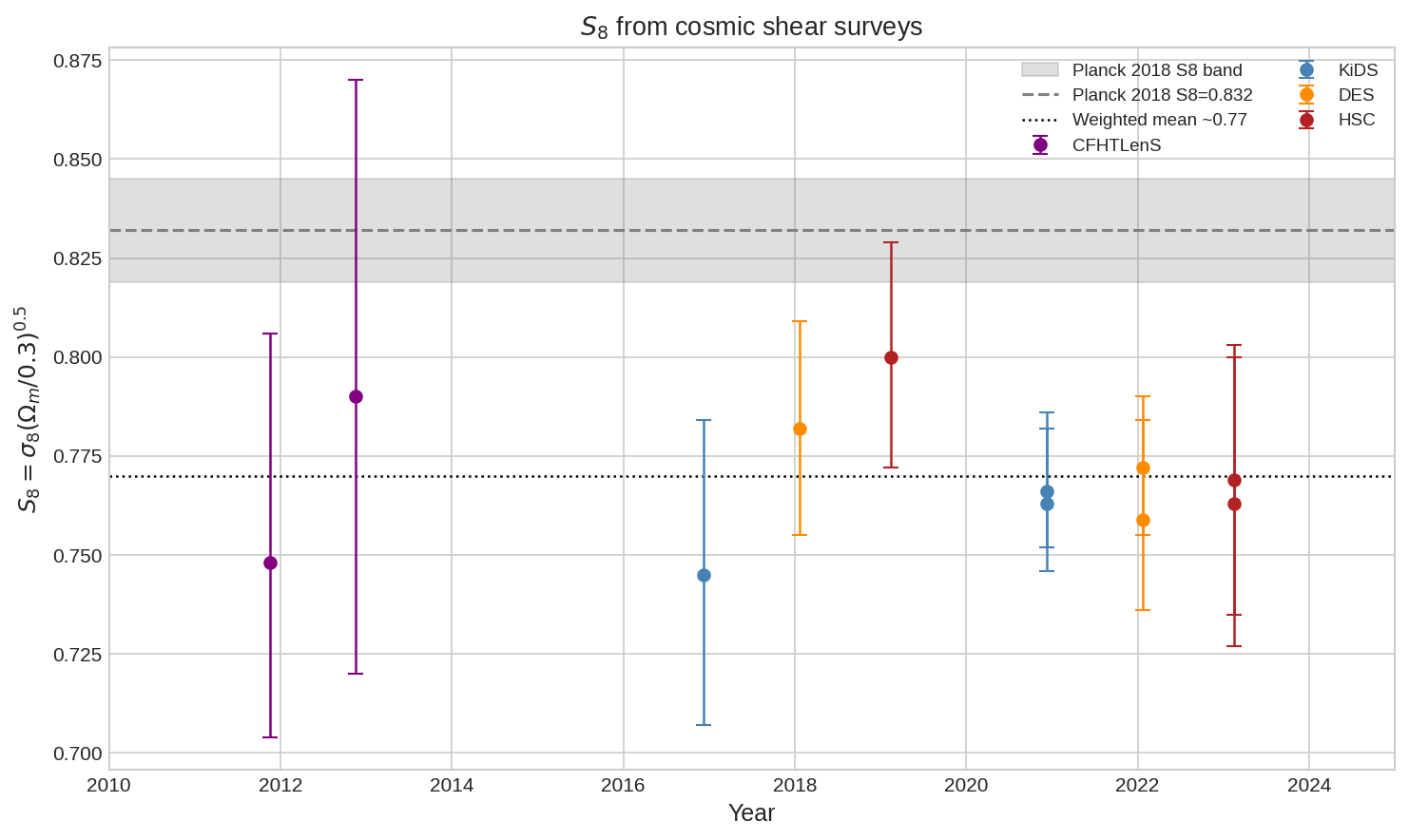
S8 constraints from all Stage-III cosmic shear surveys. The grey band shows Planck 2018 (S8 = 0.832 ± 0.013). The weighted mean of all Stage-III measurements (~0.77) lies ~3σ below Planck.
S8 summary
Overview of S8 constraints from all catalogued surveys, ordered by publication year.
Directory |
Survey |
Area (deg²) |
Nsrc |
zsource |
S8 constraint |
Cites |
|---|---|---|---|---|---|---|
CFHTLenS |
154 |
4.2 M |
0.2 – 1.3 |
0.748+0.058-0.044 |
~700 |
|
CFHTLenS |
154 |
4.2 M |
0.2 – 1.3 |
0.79+0.08-0.07 (2D) |
~600 |
|
KiDS-450 |
450 |
15 M |
0.1 – 0.9 |
0.745+0.039-0.038 |
~700 |
|
DES Y1 |
1321 |
26 M |
0.2 – 1.3 |
0.782+0.027-0.027 |
~600 |
|
HSC Y1 |
136 |
11 M |
0.3 – 1.5 |
0.800+0.029-0.028 |
~400 |
|
KiDS-1000 |
1006 |
21 M |
0.1 – 1.2 |
0.763+0.019-0.017 |
~600 |
|
KiDS-1000 (3×2pt) |
1006 |
21 M |
0.1 – 1.2 |
0.766+0.020-0.014 |
~600 |
|
DES Y3 |
4143 |
100 M |
0.0 – 2.0 |
0.772+0.018-0.017 |
~300 |
|
DES Y3 (scale cuts) |
4143 |
100 M |
0.0 – 2.0 |
0.759+0.025-0.023 |
~250 |
|
HSC Y3 |
416 |
25 M |
0.3 – 1.5 |
0.776+0.032-0.033 |
~120 |
CFHTLenS
Canada-France-Hawaii Telescope Lensing Survey: 154 deg² in 5 CFHT MegaCam fields; lensfit shear; PSF modelled from stars using lensfit.
Directory |
Statistic |
Shear |
Reference |
|---|---|---|---|
ξ+/ξ- tomographic (6 bins) |
lensfit |
MNRAS 427, 146 (arXiv:1210.0032) |
|
ξ+/ξ- non-tomographic (2D) |
lensfit |
MNRAS 430, 2200 (arXiv:1212.3338) |
KiDS
Kilo Degree Survey (VST OmegaCAM, r-band shape measurement); lensfit shear; n(z) from DIR cross-calibration with spectroscopic overlaps.
Directory |
Statistic |
Shear |
Reference |
|---|---|---|---|
ξ+/ξ- tomographic (4 bins) |
lensfit |
MNRAS 465, 1454 (arXiv:1606.05338) |
|
ξ+/ξ-, COSEBIs, bandpowers (5 bins) |
lensfit (selfcal) |
A&A 645, A104 (arXiv:2007.15633) |
|
3×2pt: ξ+/ξ- + γt + w(θ) |
lensfit (selfcal) |
A&A 646, A140 (arXiv:2007.15632) |
DES
Dark Energy Survey (DECam, riz-band shear); METACALIBRATION shear estimator (Y3); photo-z from BPZ / DNF.
Directory |
Statistic |
Shear |
Reference |
|---|---|---|---|
ξ+/ξ- tomographic (4 bins) |
IM3SHAPE + METACAL |
PhRvD 98, 043528 (arXiv:1708.01538) |
|
ξ+/ξ- tomographic (4 bins) |
METACALIBRATION |
PhRvD 105, 023514 (arXiv:2105.13543) |
|
ξ+/ξ- tomographic, scale cuts |
METACALIBRATION |
PhRvD 105, 023515 (arXiv:2105.13544) |
Note
Amon2022_DES_Y3 and Secco2022_DES_Y3 use the same source catalog
and are published simultaneously. Amon focuses on data calibration
robustness; Secco on modeling uncertainty and scale cuts.
HSC
Hyper Suprime-Cam (Subaru, i-band shape measurement); HSMRegauss shear estimator — the same pipeline used in the BGS+HSC Y3 galaxy-galaxy lensing analysis in this project; photo-z from DNNz.
Directory |
Statistic |
Shear |
Reference |
|---|---|---|---|
Cℓ power spectrum (4 bins) |
HSMRegauss |
PASJ 71, 43 (arXiv:1809.09148) |
|
Cℓ power spectrum (4 bins) |
HSMRegauss |
PhRvD 108, 123518 (arXiv:2304.00702) |
Shear estimator glossary
Estimator |
Notes |
|---|---|
lensfit |
Forward-model Bayesian shape measurement; used by CFHTLenS and KiDS |
lensfit (selfcal) |
KiDS-1000 version with self-calibration of multiplicative bias from the data |
IM3SHAPE |
Maximum-likelihood forward-model fitting; used in DES Y1 alongside METACAL |
METACALIBRATION |
Self-calibrating shear estimator using image manipulations; used in DES Y3 |
HSMRegauss |
Re-Gaussianization PSF correction (Hirata & Seljak 2003); used in SDSS, HSC |