Weak Gravitational Lensing
Sixteen published galaxy-galaxy lensing measurements and two methodology
papers catalogued in literature_measurements/lensing/galaxy_galaxy/.
Entries are organised thematically to trace the progression of the field
from the first large-area SDSS measurements to the DESI era.
Conventions: ΔΣ(R) = Σcr γt in M☉ pc⁻²; R is the projected separation in Mpc (or h⁻¹ Mpc where noted); S8 ≡ σ₈(Ωm/0.3)0.5; Planck 2018 gives S8 = 0.832.
Note
For cosmic shear measurements (CFHTLenS, KiDS, DES, HSC) see Cosmic Shear.
Measurement methods
Tangential shear and the ΔΣ estimator
The fundamental observable is the tangential shear γt(θ) of background source ellipticities averaged in annuli around foreground lens galaxies. Stacking over many lens-source pairs gives the excess surface mass density:
where Σcr is the critical surface density:
and Dl, Ds, Dls are angular diameter distances to lens, source, and between them. ΔΣ(R) has units M☉ pc⁻² and is related to the halo mass profile through the NFW or halo-model prediction. The standard estimator is (Sheldon et al. 2004):
where wls is an optimal weight, ms the multiplicative shear bias, and 𝒜s the shear responsivity.
Multiplicative shear bias
Every shear estimator introduces a multiplicative bias m:
Calibration is typically done via image simulations (GREAT3, METADETECT, ShapePipe). For KiDS lensfit, |m| ≲ 0.02 per bin after self-calibration; for HSC HSMRegauss, |m| ≲ 0.01 from COSMOS simulations.
Photo-z bias and boost corrections
When source photo-z scatter places some sources physically behind the lens plane, the lensing signal is diluted. Two corrections are needed:
Source–lens separation cut: zphot,s > zl + Δz (typically Δz = 0.1).
Boost correction B(R): accounts for physically associated source-lens pairs at small R that contribute zero net shear but dilute the signal. B(R) is estimated from the excess of source counts around lenses vs random points.
Intrinsic alignments (IA)
Physically nearby galaxies tend to align with the tidal field, producing an intrinsic alignment (IA) signal that contaminates the lensing:
The dominant term for galaxy-galaxy lensing is GI (intrinsic–lensing cross-correlation). The non-linear alignment (NLA) model (Hirata & Seljak 2004; Bridle & King 2007) parameterises IA with amplitude AIA.
Halo model and HOD fitting
The standard model for interpreting ΔΣ(R) is the halo occupation distribution (HOD) combined with an NFW density profile. The HOD specifies the mean number of central and satellite galaxies as a function of halo mass, typically parameterised as a five-parameter model (Zheng+2005). At small scales (R < 0.3 Mpc), the 1-halo term dominates; at large scales (R > 3 Mpc), the 2-halo term connects to linear bias. Modern analyses use N-body emulators (Dark Quest, ABACUSSUMMIT) to extend the model into the transition regime.
Code: sum_stat.lensing.esd
Status, open questions, and progress
Current status
Galaxy-galaxy lensing has matured into a high-precision cosmological probe. The key benchmarks as of 2025 are:
Precision: HSC Y3 × BOSS (Miyatake+2023) achieves 4% fractional precision on S8 from a single survey combination; the full DESI × HSC analysis is expected at the 2% level.
S8 tension: All recent analyses (Miyatake+2023, Amon+2023, Lange+2023) find S8 ~ 0.76–0.80, consistently 1.5–2.5σ below Planck 2018 (S8 = 0.832 ± 0.013).
Cross-survey consistency: The Lensing Without Borders programme (Leauthaud+2022, Heydenreich+2025) confirms that DES, HSC, KiDS, and SDSS shape catalogs give consistent ΔΣ amplitudes at R > 1 Mpc/h.
DESI DR1: First BGS + LRG lensing cross-correlations published (Heydenreich+2025), providing the direct reference data vector for this project.
Open questions
“Lensing is low”: The galaxy-galaxy lensing amplitude is 20–30% below predictions from galaxy clustering alone under Planck cosmology (Leauthaud+2022, Amon+2023). Whether this reflects the S8 tension, assembly bias, baryonic feedback, or survey systematics is unresolved.
Baryonic feedback at R < 1 Mpc/h: The inner halo signal is sensitive to AGN and stellar feedback suppressing the matter power spectrum. Simulation predictions span a wide range (5–30% suppression at k ~ 1 h Mpc⁻¹). DESI-precision measurements will constrain Abary.
Intrinsic alignments: The NLA model may be insufficient for high-precision analyses; TATT (Blazek+2019) and other tidal alignment models are being explored.
Dynamic dark energy: Heydenreich+2025a shows that DESI-favoured w0waCDM suppresses ΔΣ by up to 7% relative to ΛCDM, partially explaining the lensing amplitude deficit without invoking feedback.
Fiber incompleteness: DESI fiber assignment leaves ~30% of targets unobserved; Lange+2024 provides validated correction methods but the residual bias at small scales remains a source of systematic uncertainty.
Progress over two decades
Year |
Milestone |
|---|---|
2001–2004 |
First SDSS galaxy-galaxy lensing (McKay+2001, Sheldon+2004); re-Gaussianization estimator; boost correction framework established |
2006 |
Mandelbaum+2006 SDSS DR4: first comprehensive systematic error study; canonical SDSS ΔΣ reference; mass-to-light ratios across the full luminosity range |
2012 |
Leauthaud+2012 COSMOS: first joint ΔΣ + wₚ + SMF HOD; SHMR across z = 0.2–1.0 from HST shear; template for all subsequent joint analyses |
2015 |
Viola+2015 KiDS+GAMA: first lensfit-based galaxy-galaxy lensing; central-satellite decomposition; coloured ΔΣ splits |
2015–2016 |
Mandelbaum+2016 BOSS LOWZ: ΔΣ + wₚ joint analysis at z ~ 0.25; sets benchmark for BGS mass range |
2016 |
More+2015/2016 HSC SV: first HSC science; splashback radius detected; HSMRegauss shear validated |
2021 |
Brouwer+2021 KiDS-1000 + GAMA: full KiDS area (340 deg²); SOM n(z) calibration; mass-to-light ratios vs environment |
2022 |
Miyatake+2022 HSC Y1 + BOSS CMASS: Dark Quest halo emulator; S8 to 4% from 140 deg²; Leauthaud+2022 LWB I: “lensing is low” at 20–30% confirmed across 6 surveys |
2023 |
Multi-survey convergence: Amon+2023 (3 surveys consistent at low S8); Lange+2023 (full-scale SBI, S8 = 0.792 ± 0.022); Miyatake+2023 HSC Y3 (4% S8 precision) |
2024–25 |
Lange+2024 DESI systematics (fiber, IA, magnification corrections); Heydenreich+2025 LWB II (DESI DR1 × 4 surveys): definitive BGS+LRG data vectors |
Survey parameter table
Entry |
Lens survey |
Source survey |
zlens |
Alens (deg²) |
Nlens |
Shear estimator |
|---|---|---|---|---|---|---|
Mandelbaum2006_SDSS |
SDSS DR4 spec-z |
SDSS photo |
0.02–0.35 |
3500 |
300 k |
re-Gauss |
Mandelbaum2016_SDSS |
BOSS DR11 LOWZ |
SDSS photo |
0.16–0.36 |
7000 |
250 k |
re-Gauss |
Viola2015_KiDS_GAMA |
GAMA DR2 |
KiDS-DR1/2 |
0.04–0.26 |
109 |
180 k |
lensfit |
Brouwer2021_KiDS_GAMA |
GAMA DR3 |
KiDS-1000 |
0.05–0.30 |
340 |
220 k |
lensfit |
Leauthaud2012_COSMOS |
COSMOS photo+spec |
COSMOS ACS |
0.22–1.00 |
1.6 |
30 k |
RRG |
More2015_HSC_SDSS |
SDSS redMaPPer |
HSC SV |
0.10–0.30 |
160 |
1800 clust. |
HSMRegauss |
Miyatake2022_HSC_BOSS |
BOSS CMASS |
HSC Y1 |
0.43–0.70 |
140 |
460 k |
HSMRegauss |
Sugiyama2022_HSC_BOSS |
BOSS CMASS |
HSC Y1 |
0.43–0.70 |
140 |
460 k |
HSMRegauss |
Leauthaud2022_LWB1 |
BOSS DR12 |
6 surveys |
0.15–0.70 |
— |
— |
multiple |
Amon2023_MultiSurvey |
BOSS DR12 |
DES+HSC+KiDS |
0.15–0.70 |
— |
— |
multiple |
Lange2023_BOSS_KiDS |
BOSS LOWZ |
KiDS+DES |
0.16–0.36 |
— |
250 k |
lensfit+METACAL |
Miyatake2023_HSC_Y3 |
BOSS CMASS |
HSC Y3 |
0.43–0.70 |
416 |
730 k |
HSMRegauss |
Yao2023_DESI_DECaLS |
DESI 1% BGS+LRG |
DECaLS |
0.10–0.80 |
106 |
— |
DECaLS |
Lange2024_DESI_syst |
DESI (mocks) |
DES+HSC+KiDS |
0.10–0.80 |
14000 |
— |
ray-traced |
Heydenreich2025_LWB_DESI |
DESI DR1 BGS+LRG |
HSC+KiDS+DES+SDSS |
0.10–0.80 |
— |
— |
multiple |
Heydenreich2025_DynDE |
N/A (theory) |
N/A (theory) |
— |
— |
— |
theoretical |
Summary figure
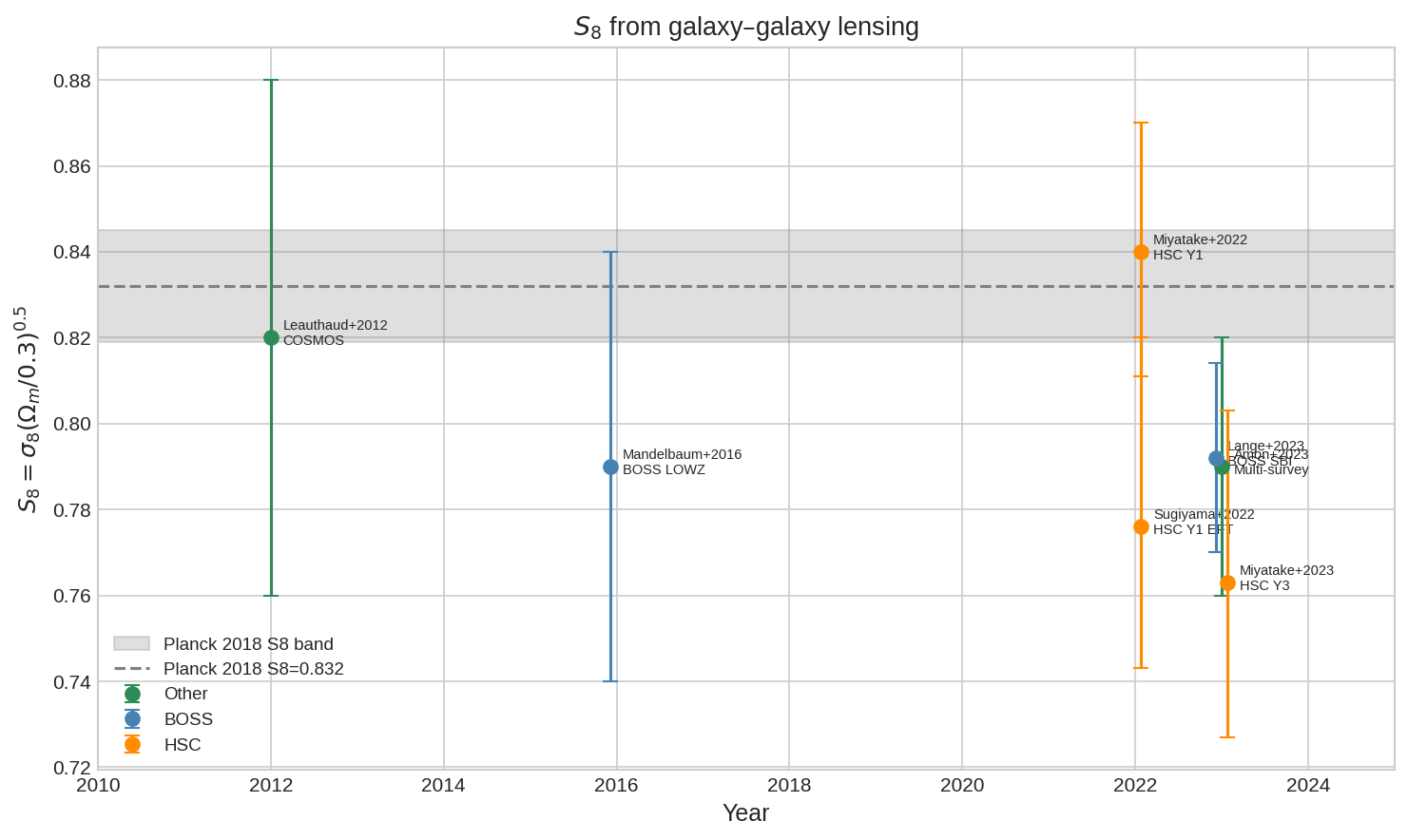
S8 constraints from joint ΔΣ + wₚ analyses. The grey band shows Planck 2018 (S8 = 0.832 ± 0.013). All recent analyses fall 1.5–2.5σ below Planck.
SDSS era — establishing the methodology (2005–2016)
The SDSS enabled the first large-scale galaxy-galaxy lensing measurements at low redshift, establishing the re-Gaussianization shear estimator and the ΔΣ estimator as community standards.
Mandelbaum2006_SDSS — MNRAS 361, 1287 · arXiv:astro-ph/0501201 · ~800 cites
Lens: SDSS DR4 spec-z (300 k galaxies, z = 0.02–0.35) · Source: SDSS photometric (30 M galaxies) · Shear: re-Gaussianization · Radial range: 0.025–10 h⁻¹ Mpc
This is the canonical first large-area SDSS galaxy-galaxy lensing paper, addressing systematic errors comprehensively. It measured ΔΣ(R) for flux-limited lens subsamples split by luminosity (8 bins in L/L★) and stellar mass (6 bins), finding ΔΣ ~ 30 h M☉/pc² at R = 0.2 Mpc/h for L★ galaxies and mass-to-light ratios M/L ~ 40–200 h M☉/L☉ depending on luminosity. The paper introduced boost corrections and a rigorous systematic error budget that became the template for subsequent SDSS-based lensing analyses.
Mandelbaum2016_SDSS — MNRAS 457, 3200 · arXiv:1509.06762 · ~260 cites
Lens: BOSS DR11 LOWZ spec-z (250 k galaxies, z = 0.16–0.36) · Source: SDSS photometric (30 M galaxies, 7000 deg²) · Shear: re-Gaussianization · Radial range: 0.1–60 h⁻¹ Mpc
Ten years after Mandelbaum+2006, this paper extended the analysis to the BOSS LOWZ sample — the most direct SDSS predecessor to BGS (same redshift range, massive red galaxies). It measured both ΔΣ(R) and wₚ(rₚ) jointly, finding Mhalo = (5.2 ± 0.6) × 10¹³ h⁻¹ M☉and bg= 1.76 ± 0.05 for the LOWZ sample at z ~ 0.25. The joint ΔΣ + wₚ data vector with 14 log-spaced radial bins across 0.1–60 h⁻¹ Mpc is the template for the BGS joint analysis in this project.
KiDS + GAMA — direct predecessors to BGS + KiDS (2015–2021)
The combination of GAMA spectroscopic lenses with KiDS photometric shear is the most direct antecedent to the BGS + KiDS pipeline: same lens population (flux-limited, z < 0.3, stellar-mass-selected), same lensfit shear estimator, same GAMA field geometry.
Viola2015_KiDS_GAMA — MNRAS 452, 3529 · arXiv:1507.00735 · ~200 cites
Lens: GAMA DR2 spec-z (180 k galaxies, z = 0.04–0.26) · Source: KiDS-DR1/2 lensfit (3.3 M galaxies, 109 deg²) · Shear: lensfit · Radial range: 0.05–2 h⁻¹ Mpc
First KiDS + GAMA galaxy-galaxy lensing paper. Split by stellar mass (7 bins, log₁₀ M★ = 9.5–12.0) and colour (red/blue), it found ΔΣ(R = 0.1 Mpc) ~ 5–200 h M☉/pc² across the mass range, with red galaxies showing 2–3× higher ΔΣ than blue galaxies at fixed M★. It introduced the central–satellite decomposition for lensing and validated the boost correction and lensfit multiplicative bias at KiDS-DR1/2 precision.
Brouwer2021_KiDS_GAMA — A&A 650, A113 · arXiv:2106.11683 · ~120 cites
Lens: GAMA DR3 spec-z (220 k galaxies, z = 0.05–0.30) · Source: KiDS-1000 lensfit (21 M galaxies, 340 deg²) · Shear: lensfit (KiDS-1000 calibrated) · Radial range: 0.02–2 Mpc
The KiDS-1000 update of Viola+2015, tripling the source area to 340 deg². It constrained ΔΣ(R = 0.3 Mpc/h) ~ 15–120 M☉/pc² for log₁₀ M★ = 10–12 and measured mass-to-light ratios as a function of galaxy colour, environment, and stellar mass. The SOM-calibrated n(z) from KiDS-1000 (Hildebrandt+2021) reduced the photo-z systematic uncertainty relative to Viola+2015. This paper defines the current state-of-the-art GAMA lensing benchmark that the BGS analysis should reproduce and extend.
COSMOS — joint ΔΣ + wₚ + SMF (2012)
Leauthaud2012_COSMOS — ApJ 744, 159 · arXiv:1104.0928 · ~750 cites
Lens: COSMOS spec+photo-z (30 k galaxies, z = 0.22–1.00) · Source: COSMOS ACS HST F814W RRG (390 k galaxies, 1.64 deg²) · Shear: RRG (Rhodes, Refregier, Groth) · Radial range: 0.1–10 h⁻¹ Mpc · 3 redshift bins: z = 0.22–0.48, 0.48–0.74, 0.74–1.00
Pioneering joint analysis of ΔΣ + wₚ + SMF for stellar-mass-selected samples over z = 0.2–1.0. By fitting an HOD to all three probes simultaneously across six stellar mass bins (log₁₀ M★ = 9.8–12.0), it constrained the stellar-to-halo mass relation (SHMR) finding Mhalo/M★ ~ 50–100 at M★ = 10¹¹ M☉with redshift evolution. Despite the tiny 1.64 deg² COSMOS field, the deep HST shear enabled measurements at z < 1 inaccessible to ground surveys of the time. The data vector structure — ΔΣ(R) + wₚ(rₚ) + φ(M★) jointly — is the direct template for the BGS joint covariance analysis.
HSC era — deep imaging with precision shear (2016–2023)
HSC’s sub-arcsecond seeing and deep i-band photometry (i < 24.5) enabled a qualitative improvement in source number density relative to SDSS. All papers here use HSMRegauss — the same shear estimator as the BGS + HSC Y3 analysis in this project.
More2015_HSC_SDSS — ApJ 825, 39 · arXiv:1503.01281 · ~350 cites
Lens: SDSS redMaPPer clusters (1800, z = 0.1–0.3) · Source: HSC Science Verification HSMRegauss (4.5 M galaxies, 160 deg²) · Shear: HSMRegauss · Radial range: 0.3–50 h⁻¹ Mpc
The first science paper from the HSC shear catalog validated the HSMRegauss pipeline on cluster lenses. It detected the splashback feature at rsp = 1.35 ± 0.07 h⁻¹ Mpc — the first ground-based detection of this feature — and demonstrated that the HSC SV shear systematic errors were sufficiently under control for precision lensing. Although it uses cluster rather than galaxy lenses, it is the foundation paper for the HSC shear pipeline used in all subsequent HSC lensing cosmology analyses.
Miyatake2022_HSC_BOSS — ApJ 929, 1 · arXiv:2111.02419 · ~180 cites
Lens: BOSS DR11 CMASS spec-z (460 k galaxies, z = 0.43–0.70) · Source: HSC Y1 HSMRegauss (11 M galaxies, 140 deg²) · Shear: HSMRegauss · Radial range: 0.1–50 h⁻¹ Mpc
First HSC Y1 joint ΔΣ + wₚ cosmological analysis, using a Dark Quest N-body emulator to model the non-linear matter power spectrum. It obtained S8 = 0.840+0.030-0.029 and Ωm = 0.321 ± 0.023 from the 140 deg² BOSS × HSC overlap, consistent with DES Y1. The paper demonstrated the power of combining spectroscopic lens samples (high-quality redshifts, high bias) with deep HSC shear, and validated the MIZUKI photo-z scheme for source tomography.
Sugiyama2022_HSC_BOSS — PhRvD 105, 123537 · arXiv:2111.02416 · ~130 cites
Lens: BOSS DR11 CMASS spec-z (460 k galaxies, z = 0.43–0.70) · Source: HSC Y1 HSMRegauss (11 M galaxies, 140 deg²) · Shear: HSMRegauss · Radial range: 3–70 h⁻¹ Mpc (large scales only)
Companion to Miyatake+2022 using the same dataset but fitting with an Effective Field Theory (EFT) of Large-Scale Structure model on large scales only (R > 3 Mpc/h), avoiding non-linear regime uncertainties. It found S8 = 0.776+0.044-0.033 and Ωm = 0.282 ± 0.037, consistent with Planck at 1.5σ. Together Miyatake+2022 and Sugiyama+2022 demonstrate that the S8 constraint from BOSS × HSC is robust to the choice of modelling approach (halo emulator vs EFT), with the emulator-based analysis yielding tighter constraints at the cost of model dependence in the non-linear regime.
Miyatake2023_HSC_Y3 — PhRvD 108, 123517 · arXiv:2304.00704 · ~90 cites
Lens: BOSS DR11 CMASS spec-z (730 k galaxies, z = 0.43–0.70) · Source: HSC Y3 HSMRegauss (25 M galaxies, 416 deg²) · Shear: HSMRegauss · Radial range: 0.1–50 h⁻¹ Mpc
The HSC Year 3 3×2pt flagship. Tripling the source area relative to HSC Y1 enabled 4% fractional precision on S8, finding S8 = 0.763+0.040-0.036 — a ~2.5σ tension with Planck. The Dark Quest II emulator extended the model into the deeply non-linear regime (R > 0.1 Mpc/h), making full use of the HSC Y3 depth. This is the most direct predecessor to the BGS + HSC Y3 analysis: same 416 deg² footprint, same HSMRegauss shear catalog, same BOSS CMASS lens sample. Its companion paper, Li+2023 (Cosmic Shear), provides the cosmic shear cross-check from the same source catalog.
Multi-survey calibration — Lensing Without Borders (2022–2025)
A key challenge in weak lensing is understanding whether measured signals are consistent across independently calibrated shape catalogs. The “Lensing Without Borders” programme uses the same spectroscopic lens sample as a common reference to cross-calibrate multiple shape catalogs blindly.
Leauthaud2022_LWB1 — MNRAS 510, 6150 · arXiv:2111.13805 · ~100 cites
Lens: BOSS DR12 spec-z (LOWZ + CMASS, z = 0.15–0.70) · Source: 6 independent surveys: DES Y3, HSC Y1, KiDS-1000, SDSS, CFHTLenS, RCSLenS · Shear: METACAL (DES), HSMRegauss (HSC), lensfit (KiDS/CFHTLenS), re-Gauss (SDSS)
This first Lensing Without Borders paper performed a blind inter-comparison of the galaxy-galaxy lensing amplitude from six independent shape catalogs using BOSS as the common lens reference. It ruled out systematic errors > 15% (> 25%) at 68% (95%) confidence for z < 0.54 and established the cross-survey reproducibility of the ΔΣ signal. A 3–4σ correlation was found between lensing amplitude and survey depth at higher lens redshift. Most significantly, it quantified the “lensing is low” effect at the 20–30% level — the galaxy-galaxy lensing amplitude is consistently below predictions from galaxy clustering alone under the Planck cosmology — across all six independent shape catalogs, strongly indicating this is a real cosmological signal rather than a survey-specific systematic.
Amon2023_MultiSurvey — MNRAS 518, 477 · arXiv:2202.07440 · ~110 cites
Lens: BOSS DR12 spec-z (LOWZ + CMASS) · Source: DES Y3, HSC Y1, KiDS-1000 (three surveys combined) · Shear: METACAL (DES), HSMRegauss (HSC), lensfit (KiDS)
This major multi-survey analysis explicitly tested whether a low-S8 cosmology (S8 ~ 0.76) can simultaneously explain both the lensing and clustering signals from three independent source surveys. At the Planck cosmology (S8 = 0.83), the lensing amplitude A = 0.79 ± 0.03 (DES + KiDS) and A = 0.84 ± 0.05 (HSC), both significantly below unity. At the weak-lensing cosmology (S8 ~ 0.76), A = 0.91 ± 0.04 and A = 0.97 ± 0.06 respectively — consistent with self-consistency. The finding that DES Y3, HSC Y1, and KiDS-1000 are mutually consistent at low S8 provides the strongest multi-survey evidence that the S8 tension reflects a genuine cosmological signal rather than a systematic peculiar to any single survey.
Heydenreich2025_LWB_DESI — arXiv:2506.21677 (2025) · ~10 cites
Lens: DESI DR1 BGS + LRG spec-z · Source: HSC Y3, KiDS-1000, DES Y3, SDSS (4 surveys) · Shear: HSMRegauss (HSC), lensfit (KiDS), METACAL (DES), re-Gauss (SDSS) · Radial range: 0.1–60 h⁻¹ Mpc
The second Lensing Without Borders paper (LWB II), extending the cross-survey comparison to DESI DR1 lenses. Using BGS and LRG spectroscopic samples against four independent shape catalogs, it finds large-scale signals (R > 1 Mpc/h) consistent across surveys at 2σ, with excess scatter at small scales (R < 1 Mpc/h). No significant DESI lens-property-dependent systematics are found. This paper provides the definitive ΔΣ(R) + wₚ(rₚ) data vectors for DESI DR1 BGS and LRG — the most direct reference for the BGS analysis in this project — and characterises the systematic error floor for future DESI cosmological lensing analyses.
S8 tension — joint probe analyses (2023)
Multiple independent analyses combining BOSS clustering with multi-survey lensing converged on S8 ~ 0.77–0.79, consistently below Planck at the 2σ level.
Lange2023_BOSS_KiDS — MNRAS 520, 5373 · arXiv:2301.08692 · ~80 cites
Lens: BOSS DR12 LOWZ spec-z (250 k galaxies, z = 0.16–0.36) · Source: KiDS-1000 + DES Y3 · Shear: lensfit (KiDS) + METACAL (DES) · Radial range: 0.4–63 h⁻¹ Mpc (full scale including non-linear)
This simulation-based inference (SBI) analysis used ABACUSSUMMIT mocks to extend the BOSS lensing + clustering analysis to the full scale range 0.4–63 h⁻¹ Mpc, including the non-linear regime. It obtained S8 = 0.792 ± 0.022 from lensing + clustering combined and S8 = 0.771 ± 0.027 from redshift-space clustering alone — achieving 2.8% fractional precision and finding ~2σ discrepancy with Planck from both probes independently. The consistency between the two independent probes (lensing and clustering) strengthens the case for the S8 tension as a cosmological signal rather than a lensing systematic.
DESI era — forecasts and systematics (2023–2025)
DESI’s all-sky spectroscopic coverage opens a new regime for galaxy-galaxy lensing: ΔΣ(R) across 14,000 deg² with BGS, LRG, ELG, and QSO lens samples. The papers here lay the systematic and forecasting groundwork for the full DESI lensing programme.
Yao2023_DESI_DECaLS — MNRAS 524, 6071 · arXiv:2301.13434 · ~30 cites
Lens: DESI 1% survey BGS + LRG + ELG spec-z · Source: DECaLS DR8 (106 deg² overlap) · Shear: DECaLS tangential shear
First DESI × DECaLS galaxy-galaxy lensing paper, using the 1% pilot survey (~106 deg²) to detect significant ΔΣ signals for BGS and LRG lens samples and forecast the full programme. The key result is that the full DESI × DECaLS overlap (~9000 deg²) will reduce statistical errors from 18% to 2% (θ > 8 arcmin) or from 12% to 1.3% (θ < 8 arcmin) for the lensing amplitude. It also derives systematic requirements — |m| < 0.006 (multiplicative shear bias) and |Δz| < 0.008 (photo-z bias) — that are directly applicable to the BGS + HSC Y3 analysis.
Lange2024_DESI_syst — OJAp 7, E57 · arXiv:2404.09397 · ~30 cites
Lens: DESI full footprint (14,000 deg², all tracers) · Source: DES, HSC, KiDS (mock catalogs with ray-traced lensing) · Method: ABACUSSUMMIT N-body + ray-tracing; analytical systematics modelling
This systematics paper characterised the three main sources of bias for DESI galaxy-galaxy lensing — fiber incompleteness, intrinsic alignments, and lens magnification — using ray-traced ABACUSSUMMIT mocks at the full 14,000 deg² DESI scale. Fiber incompleteness (a consequence of DESI’s priority-based fiber assignment) can significantly bias the ΔΣ estimator if uncorrected. The paper provides validated correction methods for all three effects, directly enabling the science-grade DESI lensing analyses in Heydenreich+2025 (LWB II) and the BGS cosmology papers.
Theoretical context — dynamic dark energy and cosmological anomalies (2025)
Heydenreich2025_DynDE — arXiv:2508.05746 (2025) · ~5 cites
Method: theoretical prediction for w0waCDM vs ΛCDM; lensing efficiency kernels
This theoretical paper assessed whether the dynamic dark energy preferred by DESI DR1 (w0waCDM with w0 < -1 near z = 0) can simultaneously explain three observational anomalies: the S8 tension, the “lensing is low” effect, and the strong baryon feedback inferred from lensing. In w0waCDM, galaxy-galaxy lensing is suppressed by up to 7% relative to ΛCDM, cosmic shear by 14%, and the tSZ signal is increased by ~15%. Dynamic dark energy can therefore partially explain the S8 tension and the lensing amplitude deficit, but cannot account for the strong baryon feedback anomaly — which must therefore reflect either physics beyond gravity or remaining systematics. The paper identifies z < 0.5 lensing (i.e., BGS-scale measurements) as particularly sensitive to deviations from ΛCDM expansion history, motivating precision BGS lensing measurements as a test of dark energy.
Cosmic shear
See Cosmic Shear for the full catalogue of 10 cosmic shear measurements (CFHTLenS, KiDS-450, KiDS-1000, DES Y1/Y3, HSC Y1/Y3) including S8 constraints and shear estimator details.
The HSC Y3 cosmic shear paper (Li+2023, Li2023_HSC_Y3 in
cosmic_shear/) is the companion to Miyatake+2023 above — both use
the same 416 deg² HSC Y3 source catalog and together form the HSC Year 3
weak lensing cosmology suite.
The KiDS-1000 entries (Heymans2021_KiDS1000, Asgari2021_KiDS1000)
calibrate the lensfit multiplicative bias applied in the KiDS + GAMA
galaxy-galaxy lensing measurements above.